英語四級考試備考正在緊張進行中,同學們備考情況如何?英語四級備考千萬要多練習英語四級的真題,這樣才能更好地了解考試重點哦!所以社科賽斯考研網小編為同學們整理了“2015年6月英語四級真題附答案(第三套)
2015年6月英語四級真題附答案第三套
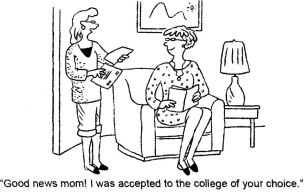
Direction.s: For this part, you are allowed 30 minutes to write an essay based on the picture below.You should start your essay with a brief description of the picture and then comment on parents' role in their children's growth. You should write at least 120 words but no more than 180 words.
Section A
Directions : In this section, you will hear 8 short conversations and 2 long conversations. At the end ofeach conversation, one or more questions will be asked about what was said. Both theconversation and the questions will be spoken only once. After each question there will bea pause. During the pause, you must read the four choices marked A, B, C. and D,and decide which is the best answer.Then mark the corresponding letter on AnswerSheet I with a single line through the centre.
1.A. The woman is the manager's secretary.
B. The man found himself in a wrong place.
C. The man is the manager's business associate.
D. The woman was putting up a sign on the wall.
2.A. He needs more time for the report.
B. He needs help to interpret the data.
C. He is sorry not to have helped the woman.
D. He does not have sufficient data to go on.
3.A. A friend from New York.
B. A message from Tony.
C. A postal delivery.
D. A change in the weather.
4. A. She is not available until the end of next week.
B. She is not a reliable source of information.
C. She does not like taking exams.
D. She does not like psychology.
5. A. He will help the woman carry the suitcase.
B. The woman's watch is twenty minutes fast.
C. The woman shouldn't make such a big fuss.
D. There is no need for the woman to be in a hurry.
6.A. Mary is not so easygoing as her.
B. Mary and she have a lot in conmon.
C. She finds it hard to get along with Mary.
D. She does not believe what her neighborssaid.
7.A. At an information service.
B. At a car wash point.
C. At a repair shop.
D. At a dry cleaner's.
8. A. The woman came to the concert at the man's request.
B. The man is already fed up with playing the piano.
C. The piece of music the man played is very popular.
D. The man's unique talents are the envy of many people.
Questions 9 to 12 are based on the conversation you have just heard.
9. A. He has taught Spanish for a couple of years at a local school.
B. He worked at the Brownstone Company for several years.
C. He owned a small retail business in Michigan years ago.
D. He has been working part-time in a school near Detroit.
10. A. He prefers a full-time job with more responsibility.
B. He is eager to find a job with an increased salary.
C. He likes to work in a company close to home.
D. He would rather get a less demanding job.
11.A. Sports.
B. Travel.
C. Foreign languages.
D. Computer games.
12. A. When he is supposed to start work.
B. What responsibilities he would have.
C. When he will be informed about his application.
D. What career opportunities her company can offer.
Questions 13 to 15 are based on the conversation you have just heard.
13.A. She is pregnant.
B. She is over 50.
C. She has just finished her project.
D. She is a good saleswoman.
14.A. He takes good care of Lisa.
B. He is the CEO of a giant company.
C. He is good at business management.
D. He works as a sales manager.
15. A. It is in urgent need of further development.
B. It produces goods popular among local people.
C. It has been losing market share in recent years.
D. It is well positioned to compete with the giants.
Section B
Directions: In this section, you will hoar 3 short passages. At tho end of each passage, you will hoar some questions. Both the passage and tho questions will be spoken only once. After youhoar a question, you must choose tho best answer from the four choices marked A, B,C. and D. Then mark tho corresponding letter on Answer Sheet I with a single linethrough tho centre.
Passage One
Questions 16 to 19 are based on the passage you have just heard.
16.A. It is lined with tall trees.
B. It was widened recently.
C. It has high buildings on both sides.
D. It used to be dirty and disorderly.
17.A. They repaved it with rocks.
B. They built public restrooms on it.
C. They beautified it with plants.
D. They set up cooking facilities near it.
18.A. What makes life enjoyable.
B. How to work with tools.
C. What a community means.
D. How to improve health.
19. A. They were obliged to fulfill the signed contract.
B. They were encouraged by the city officials' praise.
C. They wanted to prove they were as capable as boys.
D. They derived happiness from the constructive work.
Passage Two
Questions 20 to 22 are based on the passage you have just heard.
20. A. The majority of them think it less important than computers:
B. Many of them consider it boring and old-fashioned.
C. The majority of them find it interesting.
D. Few of them read more than ten books a year.
21.A. Novels and stories.
B. Mysteries and detective stories.
C. History and science books.
D. Books on culture and tradition.
22.A. Watching TV.
B. Listening to music.
C. Reading magazines.
D. Playing computer games.
Passage Three
Questions 23 to 25 are based on the passage you have just heard.
23. A. Advice on the purchase of cars.
B. Information about the new green-fuel vehicles.
C. Trends for the development of the motor car.
D. Solutions to global fuel shortage.
24.A. Limited driving range.
B. Huge recharging expenses.
C. The short life of batteries.
D. The unaffordable high price.
25. A. They need to be further improved.
B. They can easily switch to natural gas.
C. They are more cost-effective than vehicles powered by solar energy.
D. They can match conventional motor cars in performance and safety.
Section C
Directions: In this section, you will hoar a passage three times. When tho passage is read for tho first time, you should listen carefully for its general idea. When tho passage is read for tho second time, you are required to fill in tho blanks with tho exact words you have just hoard. Finally, when tho passage is read for tho third time, you should chock what you have written.
My favorite TV. show? "The Twilight Zone. " I(26)like the episode called "The Printer'sDevil. " It's about a newspaper editor who's being(27) out of business by a big newspapersyndicate--you know, a group of papers(28)by the same people.He's about to(29)when he's interrupted by an old man who says his name is Smith. The editor is not only offered $ 5,000 to pay off his newspaper's(30), but this Smith character also offers hisservices for free. It turns out that the guy operates the printing machine with amazing speed, and soon he's turning out newspapers with31 The small paper is successful again. The editor is/(32)athow quickly Smith gets his stories--only minutes after they happen--but soon he's presented with acontract to sign. Mr. Smith, it seems, is really the devil! The editor is frightened by this news, but he is more frightened by the idea of losing his newspaper, so he agrees to sign. But soon Smith is(33)the news even before it happens--and it's all terrible--one disaster after another. Anyway, there is a little more to tell, but I don't want to(34)the story for you. I really like these old episodes of "The Twilight Zone" because the stories are fascinating. They are not realistic. But then again, in a way they are, because they deal with(35).
Section A
Directions: In this sectinm, there is a passage with ten blanks. You are required to select one word for each blank from a list of choices given in a word bank following the passage. Read the passage through carefully before making your choices.Each choice in the bank is identified by a letter. Please mark the corresponding letter for each item on Answer Sheet2 with a single line through the centre. You may not use any of the words in the bank more than once. Questions 36 to 45 are based on the following passage.
As a teacher, you could bring the community into your classroom in many ways. The parents and grandparents of your students are resources and(36)for their children. They can be(37)teachers of their own traditions and histories. Immigrant parents could talk about their country of(38)and why they emigrated to the United States. Parents can be invited to talk about their jobs or a community project. Parents, of course, are not the only community resources. Employees at local businesses and staff at community agencies have(39)information to share in classrooms. Field trips provide another opportunity to know the community. Many students don't have the opporttmity to(40)concerts or visit museums or historical sites except through field trips. A school district should have41for selecting and conducting field trips. Families must be made(42)of field trips and give permission for their children to participate. Through school projects, students can learn to be(43)in community projects ranging from planting trees to cleaning up a park to assisting elderly people. Students,(44)older ones, might conduct research on a community need that could lead to action by a city council or state government. Some schools require students to provide community service by(45)in a nursing home, child care center or government agency. These projects help students understand their responsibility to the larger community.
A. Assets
B. Attend
C. Aware
D. especially
E. Excellent
F. Expensive
G. guidelines
H. involved
I. joining
J. naturally
K. observe
L. origin
M. recruited
N. up-to-date
O. volunteering
Section B
Directions: In this section, you are going to read a passage with ten statements attached to it. Each statement contains information given in one of the paragraphs. Identify the paragraph from which the information is derived.You may choose a paragraph more than once. Each paragraph is marked with a letter.Answer the questions by marking the corresponding letter on Answer Sheet 2.
Reaping the Rewards of Risk-Taking
A. Since Steve Jobs resigned as chief executive of Apple, much has been said about him as a peerless business leader who has created immense wealth for shareholders, and guided the design of hit products that are transforming entire industries, like music and mobile communications.
B. All true, but let's think different, to borrow the Apple marketing slogan of years back. Let's look at Mr. Jobs as a role model.
C. Above all, he is an innovator (創新者). His creative force is seen in products such as the iPod, iPhone, and iPad, and in new business models for pricing and distributing music and mobile software online. Studies of innovation come to the same conclusion: you can't engineer innovation, but you can increase the odds of it occurring. And Mr. Jobs' career can be viewed as a consistent pursuit of improving those odds, both for himself and the companies he has led. Mr. Jobs, of course, has enjoyed singular success. But innovation, broadly defined, is the crucial ingredient in all economic progress--higher growth for nations, more competitive products for companies, and more prosperous careem for individuals. And Mr. Jobs, many experts say, exemplifies what works in the innovation game.
D. "We can look at and learn from Steve Jobs what the essence of American innovation is," says John Kao, an innovation consultant to corporations and governments. Many other nations, Mr. John Kao notes, axe now ahead of the United States in producing what are considered the raw materials of innovation. These include government financing for scientific research, national policies to support emerging industries, educational achievement, engineers and scientists graduated, even the speeds of Internet broadband service.
E. Yet what other nations typically lack, Mr. Kao adds, is a social environment that encourages diversity, experimentation, risk-taking, and combining skills from many fields into products that he calls "recombinant mash-ups (打碎重組)," like the iPhone, which redefined the smartphone category. "The culture of other countries doesn't support the kind of innovation that Steve Jobs exemplifies, as America does," Mr. John Kao says.
F. Workers of every rank are told these days that wide-ranging curiosity and continuous learning are vital to tturiving in the modern economy. Formal education matters, career counselors say, but real- life experience is often even more valuable.
G. An adopted child, growing up in Silicon Valley, Mr. Jobs displayed those traits early on. He wasfascinated by electronics as a child, building Heathkit do-it-yourself projects, like radios. Mr. Jobs dropped out of Reed College after only a semester and traveled around India in search of spiritual enlightenment, before returning to Silicon Valley to found Apple with his friend, Stephen Wozniak, an engineering wizard (奇才). Mr. Jobs was forced out of Apple in 1985, went off and founded two other companies, Next and Pixar, before returning to Apple in 1996 and becoming chiefexecutive in 1997.
H. His path was unique, but innovation experts say the pattern of exploration is not unusual. "It's often people like Steve Jobs who can draw from a deep reservoir of diverse experiences that often generate breakthrough ideas and insights," says Hal Gregersen, a professor at the European Institute of Business Administration.
I. Mr. Gregersen is a co-author of a new book, The Innovator's DNA, which is based on an eight-year study of 5,000 entrepreneurs (創業者. and executives worldwide. His two collaborators and co- authors are Jeff Dyer, a professor at Brigham Young University, and Clayton Christensen, a professor at the Harvard Business School, whose 1997 book The Innovator's Dilemma popularized the concept of "disruptive ( 顛覆性的. innovation. "
J. The academics identify five traits that are common to the disruptive innovators: questioning, experimenting, observing, associating and networking. Their bundle of characteristics echoes the ceaseless curiosity and willingness to take risks noted by other experts. Networking, Mr. Hal Gregersen explains, is less about career-building relationships than a consistent search for new ideas. Associating, he adds, is the ability to make idea-producing connections by linking concepts from different disciplines.
K. "Innovators engage in these mental activities regularly," Mr. Gregersen says. "It's a habit for them. " Innovative companies, according to the authors, typically enjoy higher valuations in thestock market, which they call an "innovation premium (溢價). " It is calculated by estimating the share of a company's value that cannot be accounted for by its current products and cash flow. The innovation premium tries to quantify ( 量化. investors' bets that a company will do even better in the future because of innovation.
L. Apple, by their calculations, had a 37 percent innovation premium during Mr. Jobs' first term withthe company. His years in exile resulted in a 31 percent innovation discount. After his return, Applee's fortunes inmroved gradv at first, and imp)roved markedly starting in 2005, yielding a 52percent innovation premium since then.
M. There is no conclusive proof, but Mr. Hal Gregersen says it is unlikely that Mr. Jobs could havereshaped industries beyond computing, as he has done in his second term at Apple, without theexperience outside the company, especially at Pixar--the computer-animation (動畫制作. studiothat created a string of critically and commercially successful movies, such as "Toy Story" and
N. Mr. Jobs suggested much the same thing during a commencement address to the graduating class atStanford University in 2005. "It turned out that getting fired from Apple was the best thing thatcould have ever happened to me," he told the students. Mr. Jobs also spoke of perseverance ( 堅持. and will power. "Sometimes life hits you in the head with a brick," he said. "Don't losefaith. "
O. Mr. Jobs ended his commencement talk with a call to innovation, both in one's choice of work andin one's life.Be curious, experiment, take risks, he said to the students.His advice wasemphasized by the words on the back of the final edition of The Whole Earth Catalog, which hequoted: "Stay hungry. Stay foolish. " "And," Mr. Jobs said, "I have always wished that formyself. And now, as you graduate to begin anew, I wish that for you. "
46. Steve Jobs called on Stanford graduates to innovate in his commencement address.
47. Steve Jobs considered himself lucky to have been fired once by Apple.
48. Steve Jobs once used computers to make movies that were commercial hits.
49. Many governments have done more than the US government in providing the raw materials for innovation.
50. Great innovators are good at connecting concepts from various academic fields.
51. Innovation is vital to driving economic progress.
52. America has a social environment that is particularly favorable to innovation.
53. Innovative ideas often come from diverse experiences.
54. Real-life experience is often more important than formal education for career success.
55. Apple's fortunes suffered from an innovation discount during Jobs' absence.
Section C
Directions: There are 2 passages in this section. Each passage is followed by some questions orunfinished statements. For each of them there are four choices marked A, B, C. and D ). You should decide on the best choice and mark the corresponding letter on AnswerSheet 2 with a single line through the centre.
Passage One
Questions 56 to 60 are based on the following passage.
Junk food is everywhere. We're eating way too much of it. Most of us know what we're doing andyet we do it anyway.So here's a suggestion offered by two researchers at the Rand Corporation: Why not take a lessonfrom alcohol control policies and apply them to where food is sold and how it's displayed?"Many policy measures to control obesity (肥胖癥. assume that people consciously and rationallychoose what and how much they eat and therefore focus on providing information and more access tohealthier foods," note the two researchers. "In contrast," the researchers continue, "many regulations that don't assume people makerational choices have been successfully applied to control alcohol, a substance--like food--of whichimmoderate consumption leads to serious health problems. " The research references studies of people's behavior with food and alcohol and results of alcoholrestrictions, and then lists five regulations that the researchers think might be pronfising if applied tojunk foods. Among them: Density restrictions: licenses to sell alcohol aren't handed out unplanned to all comers but areallotted (分配. based on the number of places in an area that already sell alcohol. These make alcoholless easy to get and reduce the number of psychological cues to drink. Similarly, the researchers say, being presented with junk food stimulates our desire to eat it. Sowhy not limit the density of food outlets, particularly ones that sell food rich in empty calories? Andwhy not limit sale of food in places that aren't primarily food stores? Display and sales restrictions: California has a rule prohibiting alcohol displays near the cashregisters in gas stations, and in most places you can't buy alcohol at drive-through facilities. Atsupermarkets, food companies pay to have their wares in places where they're easily seen. One couldremove junk food to the back of the store and ban them from the shelves at checkout lines. The othermeasures include restricting portion sizes, taxing and prohibiting special price deals for junk foods, andplacing warning labels on the products.
56. What does the author say about junk food?
A. People should be educated not to eat too much.
B. It is widely consumed despite its ill reputation.
C. Its temptation is too strong for people to resist.
D. It causes more harm than is generally realized.
57. What do the Rand researchers think of many of the policy measures to control obesity?
A. They should be implemented effectively.
B. They provide misleading information.
C. They are based on wrong assumptions.
D. They help people make rational choices.
58. Why do policymakers of alcohol control place density restrictions?
A. Few people are able to resist alcohol's temptations.
B. There are already too many stores selling alcohol.
C. Drinldng strong alcohol can cause social problems.
D. Easy access leads to customers' over-consumption——
59. What is the purpose of California's rule about alcohol display in gas stations?
A. To effectively limit the density of alcohol outlets.
B. To help drivers to give up the habit of drinking.
C. To prevent possible traffic jams in nearby areas.
D. To get alcohol out of drivers' immediate sight.
60. What is the general guideline the Rand researchers suggest about junk food control?
A. Guiding people to make rational choices about food.
B. Enhancing people's awareness of their own health.
C. Borrowing ideas from alcohol control measures.
D. Resorting to economic, legal and psychological means.
Passage Two
Questions 61 to 65 are based on the following passage.
Kodak's decision to file for bankruptcy (破產. protection is a sad, though not unexpected, turningpoint for a leading American corporation that pioneered consumer photography and dominated the filmmarket for decades, but ultimately failed to adapt to the digital revolution. Although many attribute Kodak's downfall to "complacency ( 自滿 )," that explanation doesn'tacknowledge the lengths to which the company went to reinvent itself. Decades ago, Kodak anticipatedthat digital photography would overtake film--and in fact, Kodak invented the first digital camera in1975--but in a fateful decision, the company chose to shelf its new discovery to focus on its traditionalfilm business. It wasn't that Kodak was blind to the future, said Rebecca Henderson, a professor at HarvardBusiness School, but rather that it failed to execute on a strategy to confront it. By the time thecompany realized its mistake, it was too late.Kodak is an example of a firm that was very much aware that they had to adapt, and spent a lot ofmoney trying to do so, but ultimately failed. Large companies have a difficult time switching to newmarkets because there is a temptation to put existing assets into the new businesses.
Although Kodak anticipated the inevitable rise of digital photography, its corporate
culture was too rooted in the successes of the past for it to make the clean break necessary to fullyembrace the future. They were a company stuck in time. Their history was so important to them. Nowtheir history has become a liability.Kodak's downfall over the last several decades was dramatic. In 1976, the company commanded90% of the market for photographic film and 85% of the market for cameras. But the 1980s broughtnew competition from Japanese film company Fuji Photo, which undermined Kodak by offering lowerprices for film and photo supplies. Kodak's decision not to pursue the role of official film for the 1984Los Angeles Olympics was a major miscalculation. The bid went instead to Fuji, which exploited itssponsorship to win a permanent foothold in the marketplace.
61. What do we learn about Kodak?
A. It went bankrupt all of a sudden.
B. It is approaching its downfall.
C. It initiated the digital revolution in the film industry.
D. It is playing the dominant role in the film market.
62. Why does the author mention Kodak's Invention of the first digital camera?
A. To show its early attempt to reinvent itself.
B. To show its effort to overcome complacency.
C. To show its quick adaptation to the digital revolution.
D. To show its will to compete with Japan's Fuji Photo.
63. Why do large companies have difficulty switching to new markets?
A. They find it costly to give up their existing assets.
B. They tend to be slow in confronting new challenges.
C. They are unwilling to invest in new technology.
D. They are deeply stuck in their glorious past.
64. What does the author say Kodak's history has become?
A. A burden.
B. A mirror.
C. A joke.
D. A challenge.
65. What was Kodak's fatal mistake?
A. Its blind faith in traditional photography.
B. Its failure to see Fuji Photo's emergence.
C. Its refusal to sponsor the 1984 Olympics.
D. Its overconfidence in its corporate culture.
Directions: For this part, you are allowed 30 minutes to translate a passage from Chinese into English. You should write your answer on Answer Sheet 2.
在西方人心目中,和中國聯系最為密切的基本食物是大米。長期以來,大米在中國人的飲食中占據很重要的地位,以至于有諺語說“巧婦難為無米之炊”。中國南方大多種植水稻,人們通常以大米為主食;而華北大部分地區因為過于寒冷或過于干燥,無法種植水稻,那里的主要作物是小麥。在中國,有些人用面粉做面包,但大多數人用面粉做饅頭和面條。
參考答案:
1-8 BACBDADC
9-12 BABC
13-15 ADA
16-19 DCBD
20-22 CAB
23-25 CAD
26. especiallyc
27. driven
28. owned
29.commitsuicide
30. debts
31.shockingheadlinesc
32. amazed
33. reporting
34.trill
35. human nature
36.A. Aassets
37. E. excellent
38. L. origin
39. N. up-to-dateo
40. B. attend
41. G. guidelines
42. C. awareo
43. H. involved
44. D. especially
45. O.volunteering
46-55 ONMDJ CEHFL
56-60 BCDDC 61-65 BADAC”
以上就是小編整理的“2015年6月英語四級真題附答案(第三套)”內容,祝同學們的英語四級考試能夠高分通過,更多英語四級真題以及答案,點擊社科賽斯考研網學習。







 京公安網備11010802020593號